On 19 May we attended Base Expo at the Museum of Polish History in Warsaw — the biggest event in the BaseLinker ecosystem, drawing sellers, integrators and tool vendors from across Polish e-commerce. We went to listen to what the industry is really living with today. We came back with notes in which one thread recurs more often than any other.
It's not a new marketplace. It's not a new advertising channel. It's a lack of processes, poor data management and no automation — which together end the same way: with stockouts.
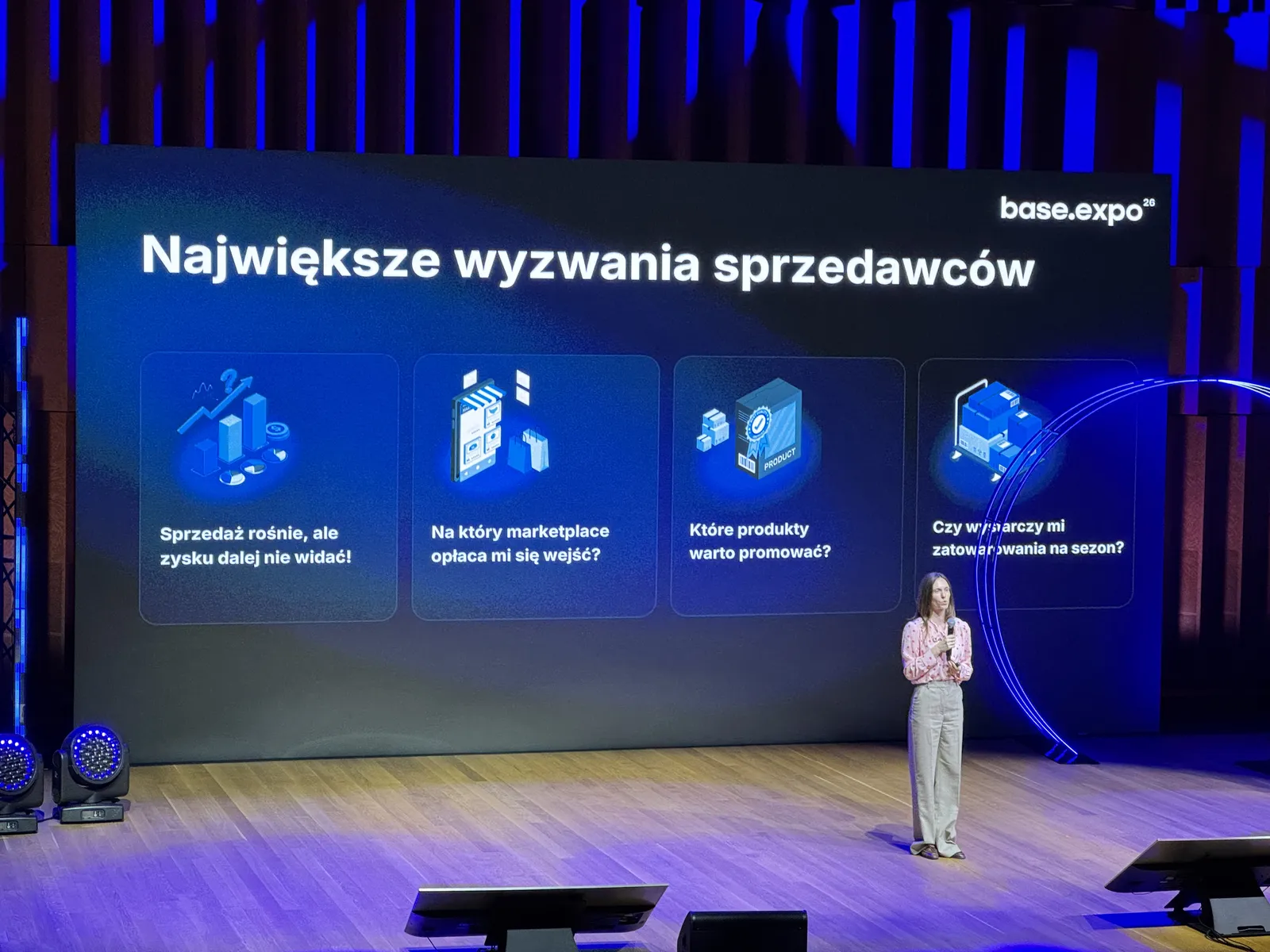
The organizer said it themselves. Right at the opening, on a slide titled "The biggest challenges sellers face", Base listed side by side: "Sales are growing, but the profit still isn't showing", "Which products are worth promoting?" and — bluntly — "Will I have enough stock for the season?". The rest of the day only confirmed it.
What really drives sales: technology, marketing or processes?
That was the title of one of the main panel discussions ("What Really Drives Sales in E-commerce Today — Technology, Marketing, or Processes?"). The panelists agreed to a surprising degree: what sells is the brand, and right behind it — the process. Technology was mentioned last, as a tool, not a cause.
The fashion examples stuck with us the most. Stores prepared campaigns and spent real advertising budgets — and then sales failed to take off, because the products weren't in stock. The money went into pulling the customer toward an offer they physically couldn't buy.
This was not a one-off example. Out-of-stock came up again and again in the discussion — as the default state, not the exception. One figure worth remembering also came up: re-acquiring a customer who left over a stockout costs roughly five times more than keeping them. An empty shelf is not just today's lost sale — it is a burned marketing budget and a customer who buys from a competitor next time.
"Stop Guessing" — the data is there, but nobody uses it
The second strong signal came from the Base Analytics session — fittingly titled "Stop Guessing. Build an Effective E-commerce Strategy Powered by Data". It showcased the growth of dashboards: views of margin, net income, sales trends.
And here is a detail straight from the stage: the host admitted that the hardest part is convincing sellers to use analytics at all. The data is being collected. The dashboards exist. Yet a large share of companies still do not even analyze margin at the level of a single SKU.
This ties into the broader picture from the whole event: data as a competitive advantage was the theme of many talks, but between "I have data" and "I make purchasing decisions based on it" lies a gap that most mid-sized stores fall into. Not out of laziness — out of a lack of time, processes and tools that would turn numbers into a decision.
Where does this problem come from? Three gaps, one outcome
Pulling together the conversations from the panels and the hallways, the pattern looks like this:
No processes. Purchasing done "by gut feel" or on a quick average of the last few weeks. Decisions postponed because nobody is sure of them. It came up plainly in conversations: where processes are not in order, the company loses the most money.
Poor data management. Sales history scattered across systems, inconsistent product records, variants and bundles counted one way one time and another the next. Even if someone wants to plan, they first have to spend weeks cleaning up the data.
No automation. Even in companies that do analyze sales, the purchasing decision is still manual work in a spreadsheet — repeated every week, prone to error and to there simply being no time for it.
The outcome is always the same: a campaign with no stock, a bestseller vanishing from the offer at the peak of the season, capital frozen in products that do not sell.
Our takeaway from Expo
We went to Base Expo to check whether the problem we solve is real. We came back more convinced than before we left — because we heard it not from ourselves, but from sellers, consultants and panelists, regardless of industry and scale.
Polish e-commerce isn't losing on technology or on marketing. It's losing on a repetitive, boring process: what to order, how much and when — done today by hand, by feel, in a spreadsheet.
That is exactly why we are building Planislav: a simple purchasing list that knows your store's sales history — accounts for seasonality and current trends — and tells you straight out: buy X units by day Y. No configuring, no 500 buttons, no yet another spreadsheet to maintain.
Stop guessing how much to order. Check out planislav.com — up to 100 SKUs free.
Were you at Base Expo? Do you see what hurts Polish e-commerce most differently? Write to us — we talk with every seller who wants to plan purchases better.