Last week you sold the last unit of your bestseller. Warehouse empty. And it was a pretty pleasant moment — "sold out" sounds like success.
The question almost nobody asks themselves: exactly how much did that empty stock cost you? Not roughly. Exactly, in cash.
If you don't know the answer, that doesn't mean it was free. It means you're paying a bill nobody shows you.
The bill you never receive
A stockout has at least three line items on an invoice you never see:
- The margin you didn't earn. The most obvious — and usually the smallest of the three. The cost of one unsold product is roughly the entire margin you would have made on it.
- The customer who went elsewhere. They searched, didn't find it with you, bought from a competitor — and quite possibly they'll stay there. A single stockout can cost you a customer for good.
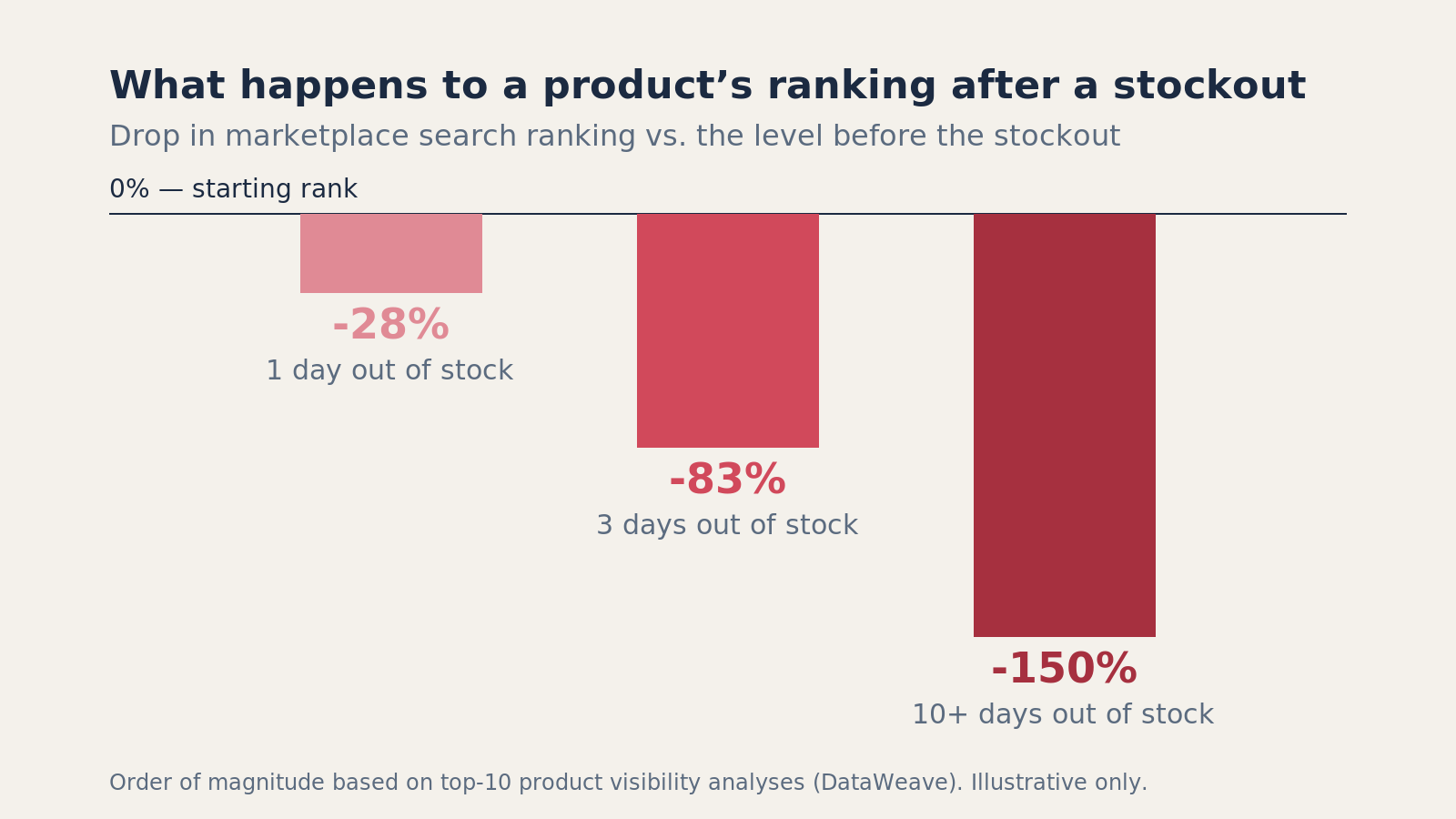
- The algorithm's penalty. This is the line item few people think about, and it's often the most expensive. A top-ten product that drops out of availability for a single day can fall in the rankings by nearly 30%. After three days — by more than 80%. A position you built over months, the marketplace wipes out in a few days. Climbing back to the top costs time, and often an extra advertising budget too.
The loop that tightens on its own
There's one more cost — the most insidious, because it works quietly.
When a product isn't there, that day's sales are zero. But a zero in the spreadsheet looks identical whether people stopped wanting your product or simply had no way to buy it.
Sales are not the same as demand. A stockout hides the real demand. You then look at that data, see a weaker month and draw the conclusion: "I'll order less." You order less, so you sell out even faster. And the circle closes.
The other side of the same coin
The natural reaction to stockouts is: "next time I'll order with a buffer." And that's where the second problem begins.
Goods sitting in the warehouse are frozen cash. Just holding inventory — financing, space, the risk of expiry or markdowns — costs around 13% of its value per year. That's money you don't have for new products, for marketing, for growth.
Out of stock and excess inventory aren't two different problems. They're one problem: guessing how much to order.
A decision you make dozens of times a month
Stop for a moment and answer honestly:
- How do you actually decide how much to order? Do you look at what's left on the shelf? At the last month? At a hunch?
- How much time a week goes into these decisions? An hour? Five? A whole Sunday evening with Excel?
- Do you know how much one order to a supplier costs you — not the goods themselves, but your time, transport, the logistical minimum?
- How much cash do you have right now frozen in goods that just sit there and don't sell?
- And this one: have you ever calculated how much a single day without your best product costs you?
The cheapest first step
It's not about having more of everything. It's about knowing, for each product separately, where the line is between "too little" and "too much".
Most sellers don't calculate that line — because it seems impossible to do for 2,000 SKUs at once. It's possible. But that's a topic for a separate conversation.
The first step is free and you can take it today: take your best-selling product and calculate one number — how much you earn on it on an average day. That's exactly how much you lose every day it's out of stock.
The rest starts with simply having asked yourself the question.
— The Planislav Team