What is a SKU? A SKU (Stock Keeping Unit) is a unique SKU code — also called an SKU number — that you assign yourself to every variant of a product so you can identify it without any doubt. It's your internal identifier, not a barcode issued globally. If you run a small online shop, sell on a marketplace, or take orders through social media, good SKUs are the first step to stop guessing what and how much to order.
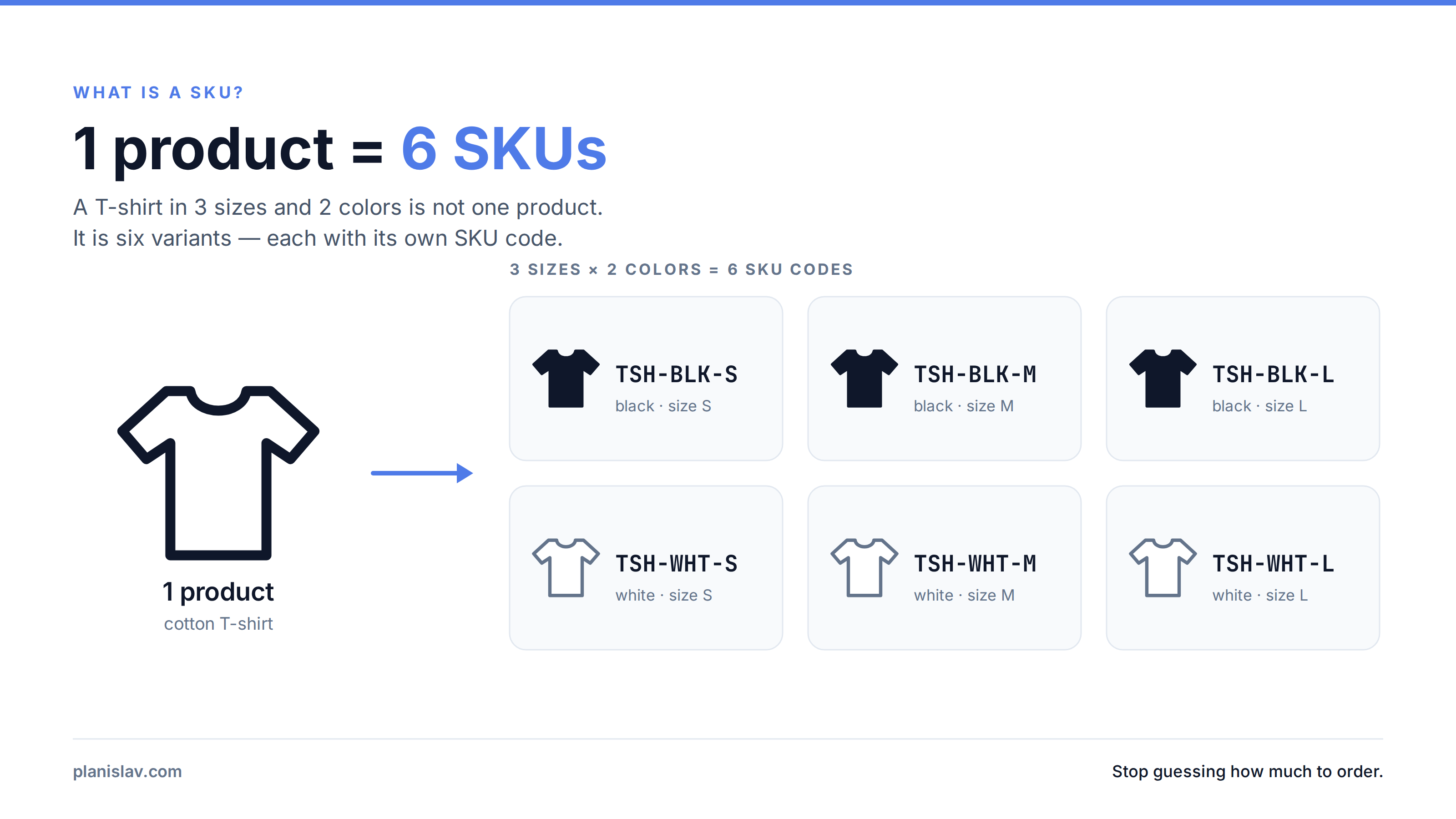
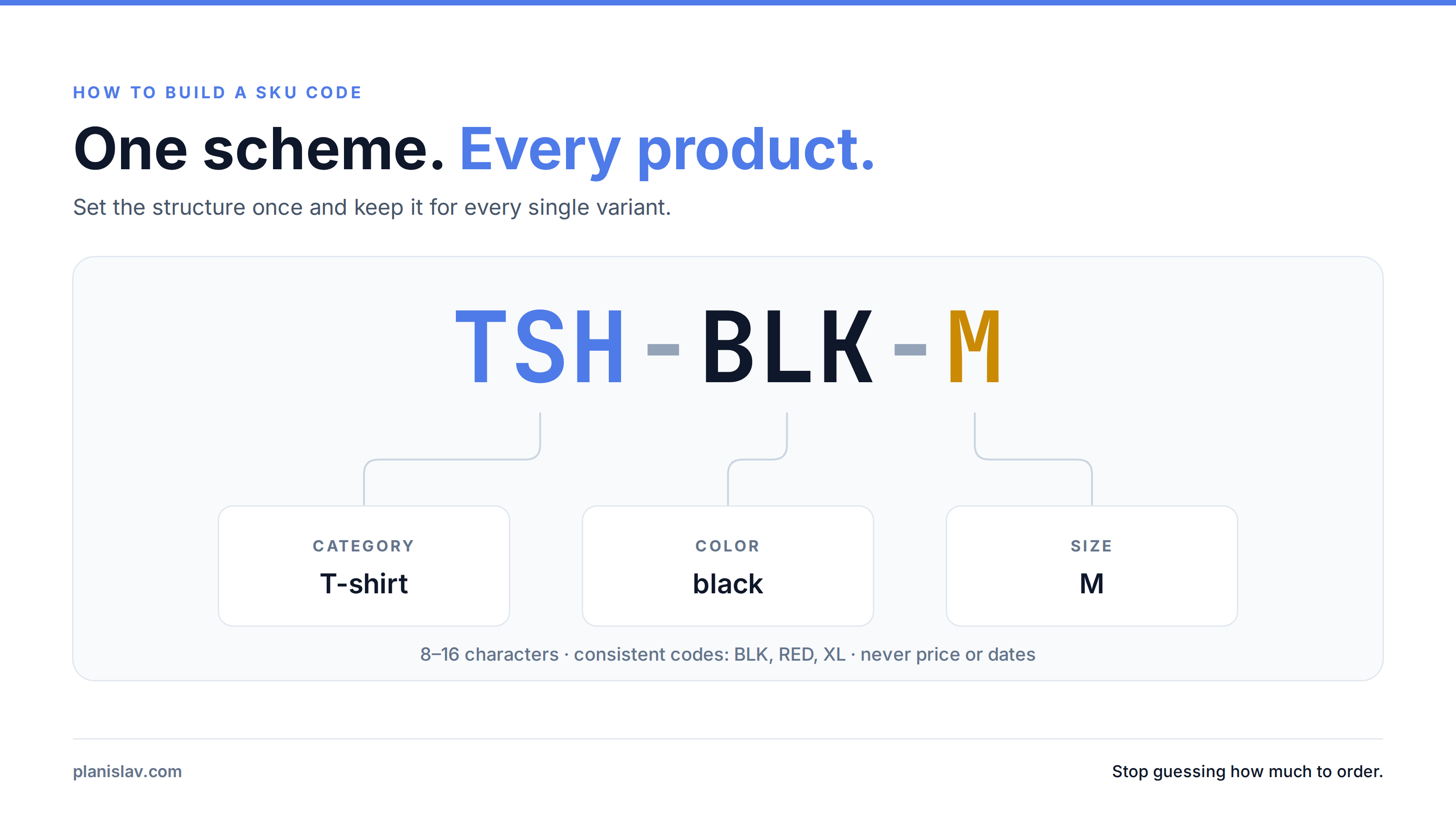
In a nutshell: it's a unique code for a single product variant (e.g. TSH-BLK-M = T-shirt, black, size M). You create it yourself, it's internal, and it's used to count stock, fulfil orders and analyse sales.
Sound familiar? One product just sold out — right when customers want it. Another has been sitting in a box for six months, freezing your cash. Getting a handle on that chaos starts with the SKU. In this guide — in plain English — we cover the definition, the difference between a SKU and an EAN, how to build a good code, real examples, common mistakes, and the questions people ask most.
What is a SKU? The definition
SKU (pronounced “skew”) stands for Stock Keeping Unit. It's a unique code you assign to every variant of a product.
The key word is variant. If you sell a T-shirt in three sizes and two colors, that's not one product — it's six different SKUs. Because your warehouse, your customer and your wallet all treat a black size-M shirt very differently from a white XL. The SKU number lets you tell them apart in every system: your shop, a spreadsheet, your courier's label.
SKU vs EAN, GTIN and UPC — what's the difference?
Here's the most common mix-up: confusing an SKU code with a barcode. The difference is fundamental — a SKU is yours and internal, while an EAN/GTIN is global and official. Here's every code you'll meet in e-commerce:
- SKU — assigned by you, the seller. It works inside your business only. Used for variant identification, inventory and sales analysis.
- EAN — assigned by GS1 or the manufacturer. Global scope (mainly Europe). It's the product barcode: checkout, marketplaces, logistics.
- GTIN — assigned by GS1 or the manufacturer. The umbrella standard covering EAN and UPC — the general trade item number.
- UPC — assigned by GS1 or the manufacturer. Global scope (mainly US and Canada), 12 digits.
- ASIN — assigned by Amazon. An internal product identifier in Amazon's catalog.
An analogy: an EAN is like a product's official ID number — one, global, identical for every seller. A SKU is your own “nickname” for that product in your shop — you set it up however works best for you.
Why does a micro business need SKU codes? I remember my own products
With five products, sure, you can keep it all in your head. The problem is that your business grows and your memory doesn't. At 30, 50 or 200 variants, “that blue hoodie, the nicer one” stops working.
A good SKU number lets you count stock quickly, communicate clearly with your supplier and courier, avoid shipping the wrong variant, and combine sales from different channels — your shop, a marketplace, Instagram — into a single number. Most importantly, it lets you analyse what actually sells and what just takes up shelf space.
That last point is the foundation of smart purchasing. Without SKUs, you don't know how many units of a specific variant moved last month. And if you don't know that, ordering your next batch is just… guessing.
How to create a good SKU code: 5 rules
- Design it for a human, not just a system. The code should tell you something. MUG-RED-350 reads far better than 000582.
- Stick to one structure. Set a pattern, e.g. Category-Color-Size, and use it every single time, for every product.
- Use short, consistent abbreviations. BLK, RED, XL. Separate parts with a hyphen or underscore. A sensible length is usually 8–16 characters — short enough to read, long enough to stay unique.
- Avoid confusing characters. The letters O and I next to the digits 0 and 1 are asking for a mistake. Don't start a code with a zero either — spreadsheets tend to “eat” it.
- Don't encode things that change. Never bake price or delivery dates into a SKU. The price will change, but the SKU should stay fixed for the entire life of the product.
SKU examples — from scratch
You sell cotton tote bags in 2 patterns (stripes, dots) and 2 colors (beige, navy). Pattern: TOT-[pattern]-[color].
- TOT-STR-BEI — striped tote, beige
- TOT-STR-NAV — striped tote, navy
- TOT-DOT-BEI — dotted tote, beige
- TOT-DOT-NAV — dotted tote, navy
And here's how it looks in other industries:
- Apparel: TSH-BLK-M (T-shirt, black, M)
- Beauty: CRM-MOI-50 (moisturizing cream, 50 ml)
- Electronics: CBL-USBC-1M (USB-C cable, 1 meter)
Four variants or forty — the rule is the same: each one gets a single, consistent code you tag every sale and delivery to.
The most common SKU mistakes
- One SKU for several variants. The classic: all sizes under a single code. The result? You don't realise you're out of size M, even though “you have 20 shirts in stock”.
- Changing the pattern halfway. Half your products coded the old way, half the new way — that's worse than having no SKUs at all.
- Duplicates. Two different products sharing one code is a guaranteed shipping error.
- Encoding price or promotions in the SKU. The code should identify the product, not its temporary price.
Does every shop need SKUs?
The law doesn't require them — a SKU is your tool, not an obligation. But in practice, once you have a dozen variants, the lack of consistent codes costs you time and mistakes. The sooner you introduce a SKU system (even in a spreadsheet), the easier it is to later move to a shop, a marketplace or a purchasing tool without rewriting everything from scratch.
From SKUs to smart purchasing
Clean SKUs aren't the goal in themselves — they're the foundation. When every variant has its own code, your sales history becomes readable: you can see that TSH-BLK-M sells three times faster than TSH-WHT-XL.
And that's where the real savings begin. Instead of ordering “evenly” or “by gut feel”, you can order exactly as much as you actually sell — and at the right time, before you run out.
That's precisely what Planislav does. It analyses your sales history at the SKU level and tells you what to order, how much and when. No more empty shelves at peak season, and no more cash frozen in stock that just sits there. But it all starts with the one thing you've just mastered: a solid SKU.
FAQ — the questions people ask most about SKUs
Can I create my own SKU number? Yes. A SKU is internal — you assign it yourself using any consistent pattern. No registration or external authority is required.
Is a SKU the same as a product code (EAN)? No. An EAN/GTIN is a global barcode issued by GS1 or the manufacturer, identical for every seller. A SKU is yours and works only inside your business.
How many characters should a SKU code have? Usually 8–16 characters. Short enough to read and type, descriptive enough to point to one variant unambiguously.
Can two products have the same SKU? No. Uniqueness is the whole point of a SKU. A duplicate means errors in stock levels and shipping.
Does every product need a SKU? There's no legal requirement, but as your catalog grows, the lack of SKUs quickly becomes costly. It's worth setting them up from the start.
Does a SKU affect a shop's SEO? Indirectly. The SKU itself isn't a ranking factor, but order in your variants makes for cleaner URLs, fewer duplicate-content issues and better product-page management.
Want to stop guessing how much to order? See how Planislav turns your SKU-level sales history into concrete purchasing decisions — planislav.com